
CINEMATIC TITLE DESIGN · INDEPENDENT STUDY · 2026
The Far Shore
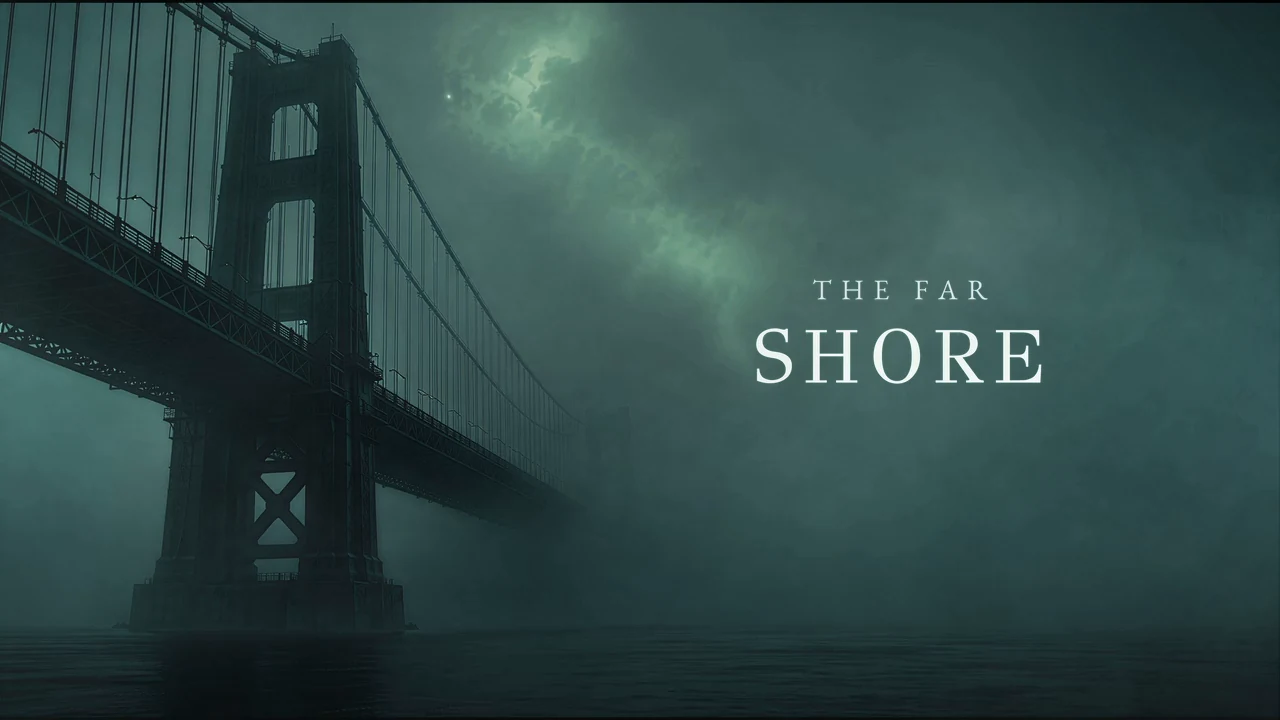
A monumental crossing through sea-green fog. The subject is not the destination—it is the distance, weight and uncertainty of reaching it.
The idea
A bridge normally promises passage from one place to another. Here it is treated as a structure disappearing into uncertainty. The viewer can identify the weight of the steel, the direction of the crossing, and the void beyond—but not the destination.
This is an independent title-design exercise, not an opening commissioned for an existing film. The cinematic premise was intentionally spare: let architecture, atmosphere and duration imply a larger story.
The real production problem
The challenge was not generating a dramatic image of a bridge. It was preserving a believable suspension-bridge structure across variations of angle, camera distance and motion. Image models may independently reinterpret tower openings, roadway position, cross-bracing, hanging cables and the underside truss.
A convincing shot becomes unusable if the roadway appears to pass through bracing or the bridge changes engineering logic between views. The iterative visual-development process therefore emphasized structural correction and reference consistency before movement, rather than accepting attractive but incoherent frames.
- One continuous road deck at a consistent elevation between the tower legs
- Structural cross-bracing below, not intersecting, the deck
- Legible trusses, hangers and suspension-cable relationships
- Fog that conceals distance without erasing the bridge's overall mass
Move slowly enough for the bridge to feel massive; reveal little enough for the destination to remain unknown. A restrained camera can be more expressive than a spectacular move when scale and uncertainty are the actual subjects.
Movement and editorial control
Frames were evaluated as parts of one sequence rather than isolated images. The visual grammar favors controlled motion, long enough holds to register geometry, cold atmospheric color, selective highlights and minimal disruption between shots.
Image-to-video tests, including ComfyUI/LTX and MiniMax H3 exploration, were evaluated for steady camera behavior and preservation of recognizable structural elements. Final shot choice, rhythm and finishing remained editorial decisions. The process was iterative; it did not rely on a fully geometry-locked 3D bridge.
What the result demonstrates
- Cinematic concept development from a single spatial idea
- Compositional continuity across AI-assisted visual material
- Atmosphere and perspective as narrative tools
- Image-to-video direction, shot selection, pacing and finishing
- Experience transferring traditional 3D and architectural reasoning into AI-assisted production
The final work is a speculative example of the approach I bring to opening sequences for films, series, games and cultural projects—not a claim of a commissioned client delivery.
Watch the film
Watch the complete published sequence below, or open it on Vimeo.
Video produced as an independent title-design study. Please refer to the original video for its final audio/music credit details.